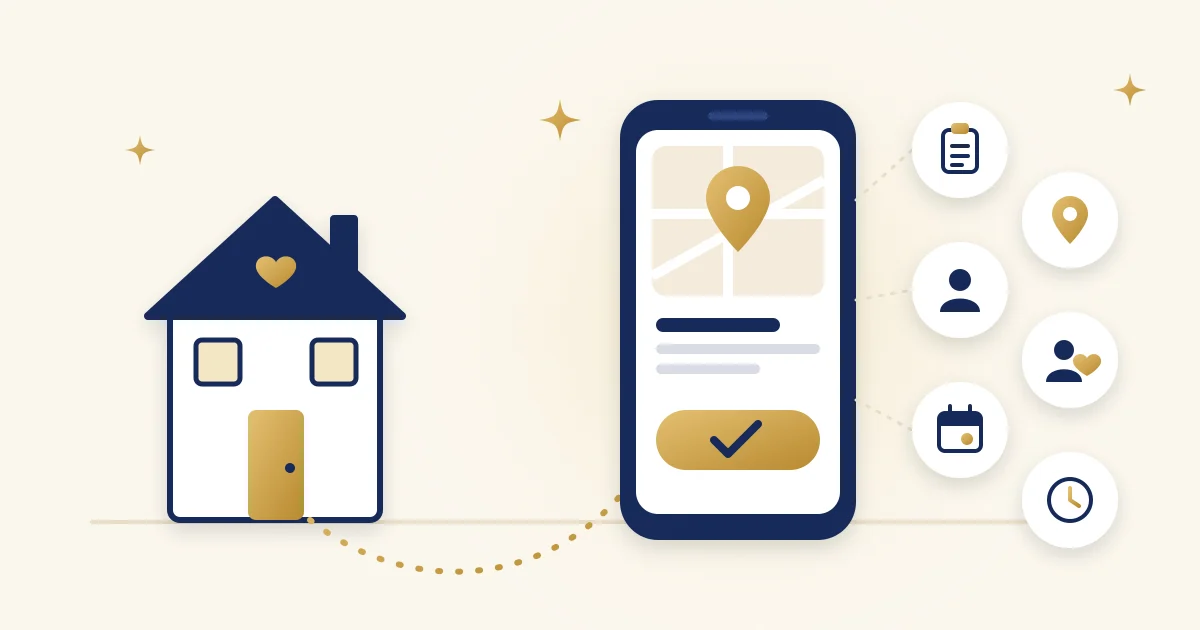
EVV stands for electronic visit verification. It is a system that records, at the time of the visit, who provided care, who received it, what service was delivered, where, and when it started and ended. Federal law requires every state to use EVV for Medicaid-funded personal care and home health visits, and in Illinois that includes in-home services paid through state waiver programs.
If you run a non-medical home care agency in Illinois and you bill any Medicaid program, EVV is not optional. The rest of this guide covers what the law actually requires, how Illinois set up its system, and what to look for in the app your caregivers use every day. For a step by step checklist of the Illinois process, see our Illinois EVV process guide.
What does EVV stand for, and what does it record?
EVV means electronic visit verification. Instead of a paper timesheet signed at the end of the week, the caregiver checks in and out electronically at the client's home, and the system stores the visit details as they happen.
The 21st Century Cures Act sets six data points every EVV system must capture. The Illinois Department of Healthcare and Family Services (HFS) lists the same six:
| # | Data point | What it means in practice |
|---|---|---|
| 1 | Type of service performed | The service code or task, such as in-home personal care |
| 2 | Individual receiving the service | The client |
| 3 | Date of the service | The calendar date of the visit |
| 4 | Location of service delivery | Where the visit started and ended |
| 5 | Individual providing the service | The caregiver |
| 6 | Time the service begins and ends | Clock-in and clock-out times |
Miss any one of these and the visit is incomplete. That is where most EVV problems start: a missed clock-out, a visit logged under the wrong client, or a caregiver who forgot to check in and called the office instead.
Is EVV a federal law?
Yes. Section 12006(a) of the 21st Century Cures Act, passed by Congress in 2016, requires states to implement EVV for Medicaid personal care services and home health services that require an in-home visit. According to Medicaid.gov, states had to require EVV for personal care services by January 1, 2020 and for home health services by January 1, 2023. States that miss the deadlines face reductions in their federal Medicaid matching rate unless they show a good faith effort and unavoidable delays.
The law puts the obligation on the state. The state then passes it to you through its Medicaid programs and managed care contracts. So for an agency owner, the practical answer is simple: if a Medicaid program pays for the visit, expect it to need EVV.
Who has to use EVV in Illinois?
HFS lists the programs where EVV applies. For personal care services, these are home and community based services (HCBS) waivers that cover help with activities of daily living such as bathing, dressing, grooming and meal preparation:
- Persons with Disabilities waiver
- Brain Injury waiver
- HIV/AIDS waiver
- Elderly Waiver
- Adults with Developmental Disabilities waiver
- Children and Young Adults with Developmental Disabilities Support waiver
For Illinois Department on Aging (IDoA) providers, the date to watch is March 2, 2026. HFS set that as the implementation date for bringing EVV data from IDoA and IDHS Division of Rehabilitation Services providers into the state's EVV system. If your agency delivers in-home service through the IDoA Community Care Program, which covers household tasks plus personal care like dressing, bathing and grooming, this applies to you.
If you serve clients through an Illinois Medicaid managed care organization (MCO), confirm the EVV requirements in your MCO contract and provider notices, and ask each plan how it wants visit data submitted.
How does EVV work in Illinois?
Illinois is a hybrid EVV state. In March 2022, HFS selected HHAeXchange as the state's EVV vendor and aggregator. HFS explains that agencies can use any qualified EVV vendor, but the EVV information must still be submitted to HHAeXchange. An agency using a different EVV system has to make sure that system is compatible with the state's Electronic Data Interchange (EDI) process.
In plain terms, you have two paths:
- Use the state vendor's system. Your caregivers clock in and out through the state vendor's tools.
- Use your own agency software. Your system captures the visit, and the data goes to the state aggregator through the EDI process.
The second path makes sense if you want EVV in the same system you already use for scheduling, billing and payroll. When EVV lives somewhere else, the office ends up matching visits by hand between two systems, and every mismatch becomes a billing delay.
For help with the state's system, HFS lists the Illinois EVV Helpline at 1-833-961-7429. Questions for HFS go to HFS.EVV@illinois.gov.
Does EVV track your location?
EVV records location at the start and end of a visit. It does not follow the caregiver around all day. The federal CMS EVV FAQ says capturing the location where the service starts and stops is enough to meet the Cures Act minimum. States may ask for more to control fraud.
CMS also says there is no federal requirement to use GPS. GPS is one approach. Another is a phone check-in from the client's home. A mobile app with GPS is a simple way to show a caregiver was at the right address when the visit started and ended.
Explain this to caregivers directly. Some worry the app tracks them after their shift. A short talk at onboarding about what is recorded, and when, makes it more likely they will actually use the app.
What does "EVV verified" mean?
In practice, a visit counts as verified when all six data points are captured and line up with what was scheduled and authorized. That is the visit you can bill with confidence.
A visit that is not verified usually has one of these problems:
- Caregiver forgot to clock in or clock out
- Clock-in happened away from the client's address
- Visit time does not match the scheduled or authorized hours
- Wrong client or wrong service selected
- A manual edit was made without a reason recorded
Each unverified visit needs someone in your office to review and correct it before billing. A good EVV setup catches these the same day, while the caregiver still remembers what happened, not three weeks later when the claim comes back.
Who is exempt from EVV?
Federal guidance says EVV does not apply when the caregiver and the person receiving care live together. CMS stated this in an August 2019 informational bulletin. In Illinois, HFS published a May 10, 2023 informational notice on the live-in caregiver exemption for IDHS Division of Developmental Disabilities waiver programs.
HFS also lists services that do not require EVV, including hospice and durable medical equipment. Those are outside non-medical home care anyway.
If you think a client or caregiver qualifies for an exemption, check the current rules for that client's specific program before you stop collecting EVV.
Do private pay and VA visits need EVV?
The Cures Act mandate covers Medicaid-funded services. Private pay visits fall outside it. Even so, there is a case for running EVV on every visit, whatever the payor: one process for caregivers to learn, clean timesheets for payroll, and proof of service if a family questions an invoice.
VA home care has its own authorization and documentation rules. Check your VA agreement for what visit records it expects.
What to look for in EVV software
The EVV app is the part of your system caregivers touch every shift. If they struggle with it, your office pays for it in corrections. When you compare options, check:
- Captures all six federal data points on every visit
- Works on both iPhone and Android, since caregivers use their own phones
- Clock-in and clock-out with GPS location
- Flags missed or late clock-ins the same day
- Ties each visit to the schedule, so verified visits flow into billing
- Uses the same verified hours for payroll
- Produces data that is export-ready for Illinois submission
- Keeps an audit trail of every edit, with who made it and why
Companio is EVV-ready home care software built for Illinois agencies. Caregivers clock in and out on iPhone or Android, Companio captures all six federal EVV data points, and the visit data is export-ready for Illinois submission. The same verified visits drive your schedule, your IDoA, VA, MCO and private pay billing, and your payroll reports. See how it works on the Companio EVV page.
Where to start
If you are setting up EVV for the first time, or switching systems:
- Confirm which of your clients are funded by programs that require EVV.
- Read the HFS EVV page and your MCO provider notices for current submission rules.
- Decide whether you will use the state's option or your own EVV system through EDI.
- Train caregivers on clock-in and clock-out before the first shift, not after the first missed visit.
- Review unverified visits daily.
If you want to see what EVV looks like when it lives in the same system as your schedule and billing, book a demo and we will walk through it with your payor mix in mind.
Frequently asked questions
What is EVV in home care?
EVV, or electronic visit verification, is an electronic record of each in-home visit. It captures the service type, the client, the date, the location, the caregiver, and the start and end times. Federal law requires it for Medicaid-funded personal care and home health visits.
What does "EVV clock in" mean?
An EVV clock-in is the caregiver's electronic check-in at the start of a visit, usually through a mobile app at the client's home. It records the start time and location. The clock-out at the end records the end time and location.
Is EVV a federal law?
Yes. Section 12006(a) of the 21st Century Cures Act requires states to implement EVV for Medicaid personal care and home health services that require an in-home visit. Each state, including Illinois, sets up its own system to meet the requirement.
Does EVV track your location?
Only at the start and end of a visit. CMS says capturing the location where service begins and ends meets the federal minimum, and GPS is not required by federal law, though most apps use it.
What EVV system does Illinois use?
Illinois selected HHAeXchange as its EVV vendor and aggregator in March 2022. Agencies may use another qualified EVV system, but the visit data must still be submitted to HHAeXchange through the state's EDI process.